Juyondai was featured in dancyu magazine
July 11, 2025
Series: “The New Sake World Opened by Juyondai — The Work and Influence of 15th-Generation Brewer Tatsugorō Takagi.”
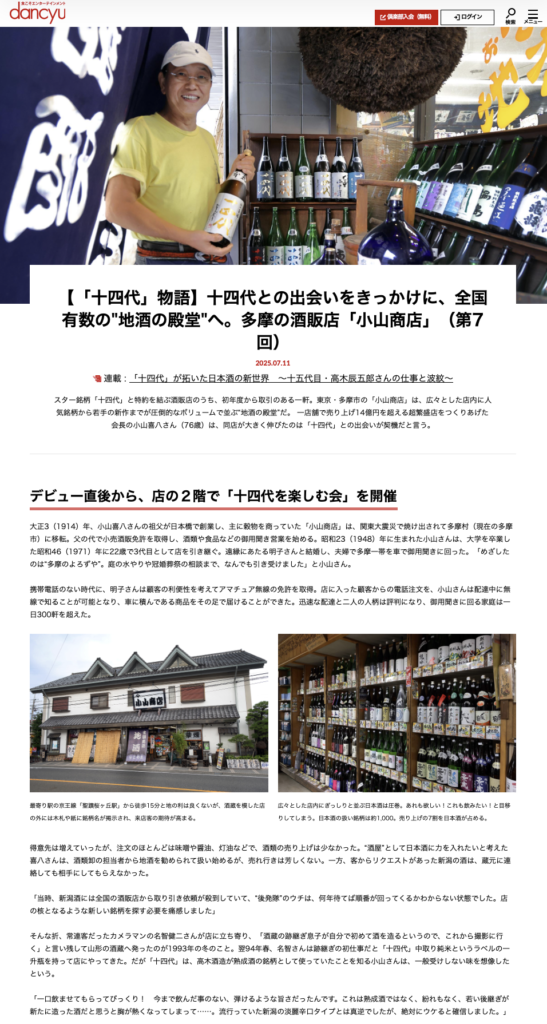
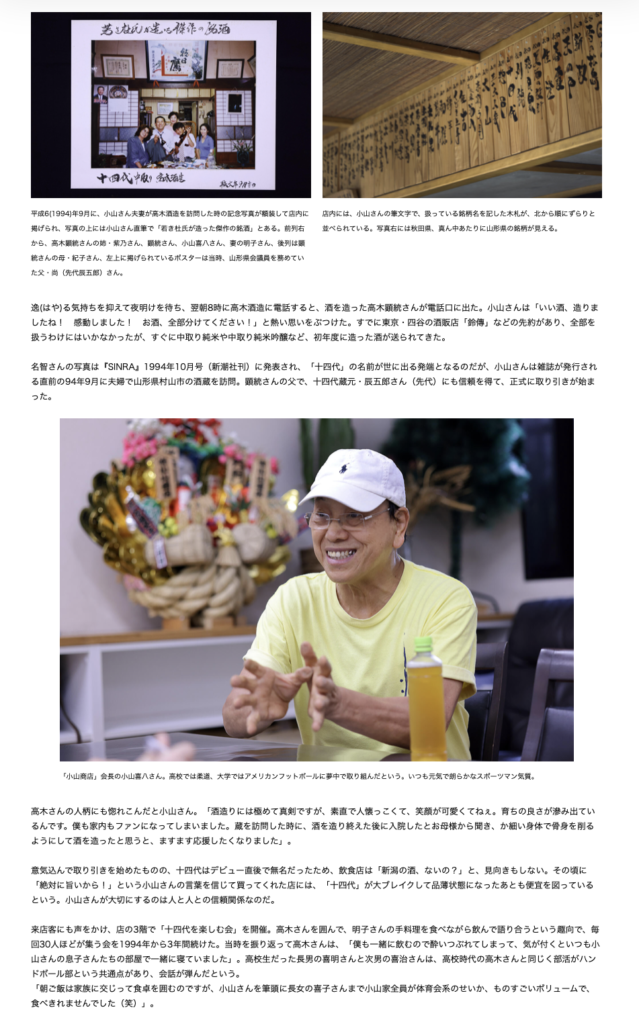
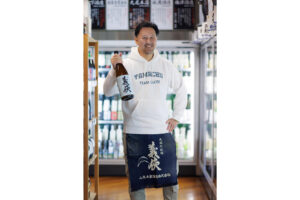
Among the liquor shops that have a special contract with the star brand Juyondai, one has carried it since the very first year. Koyama Shoten in Tama, Tokyo, lines its spacious shelves with everything from famous labels to bottles by young brewers, earning the nickname “hall of local sake.” Chairman Kihachi Koyama (age 76) built a single-store business that now sells over 1.4 billion yen a year, and he says their big leap began the moment they met Juyondai.
From the start, the shop held “Enjoy Juyondai” gatherings on its second floor.
Koyama Shoten started in 1914 in Nihonbashi, run by Kihachi’s grandfather as a grain merchant. After the Great Kantō Earthquake, the family relocated to Tama Village (today’s Tama City). His father later obtained a retail liquor license and began door-to-door sales of sake and groceries. Born in 1948, Kihachi took over at age 22 after graduating from university in 1971. He married Akiko, a distant relative, and the couple drove around Tama taking orders. “We aimed to be the ‘general store of Tama,’ handling everything from watering gardens to advice on weddings and funerals,” he recalls.
In the days before cell phones, Akiko earned an amateur-radio license to make ordering easier. While Kihachi was out delivering, the shop could radio new phone orders to him, and he would drop off items straight from his van. Their speedy service and friendly manner earned praise, and they visited more than 300 homes a day.
Although their customers grew, most orders were for miso, soy sauce, or kerosene, and liquor sales stayed low. Wanting to be a true “sake shop,” Kihachi started stocking regional sake on a wholesaler’s advice, but it didn’t sell well. He also tried to source popular Niigata sake requested by customers, yet the breweries ignored his calls.
“Back then, Niigata sake was flooded with requests from shops nationwide, so we, the latecomers, had no idea how many years we’d wait for a turn. I knew we needed a new core brand,” he says.
One winter in 1993, Kenji Nachi, a regular customer and photographer, stopped by and said he was off to shoot a brewer’s heir making his very first sake. The next spring, he returned with a 1.8-liter bottle labeled “Juyondai Naka-dori Junmai,” the heir’s first product. But Koyama knew Juyondai had been used for matured sake at Takagi Brewery, so he expected a taste that wouldn’t appeal to average drinkers.
“One sip shocked me! The flavor was vibrant like nothing I’d tried. It wasn’t an aged sake at all—it was clearly a fresh creation by a young successor, and my heart raced. It was the exact opposite of the light, dry Niigata style that was trendy, but I knew it would catch on.”
He waited for dawn, then called Takagi Brewery at 8 a.m. The brewer, Akinori Takagi, answered. “You made a great sake! I was moved. Please let me have all of it!” Koyama said. Some stock was already promised to other shops like Suzuden in Yotsuya, Tokyo, so he couldn’t get it all, but bottles of Naka-dori Junmai and Junmai Ginjo from the first batch soon arrived.
Nachi’s photos appeared in the October 1994 issue of SINRA magazine, bringing the name Juyondai into the spotlight. Just before the issue came out, in September 1994, the Koyamas visited the brewery in Murayama, Yamagata. They earned the trust of Akinori’s father, the 14th-generation brewer Tatsugorō Takagi, and a formal business relationship began.
Koyama also fell for Takagi’s personality. “He is serious about brewing, yet honest, friendly, and has a warm smile. You can tell he was raised well. My wife and I became fans. His mother told us he had to be hospitalized after finishing the brew—imagining his thin body sacrificing everything for the sake made us want to support him even more.”
Even after he began selling it, Juyondai was unknown, and restaurants asked only for Niigata sake. The few that trusted Koyama’s “It’s definitely good!” and bought Juyondai early were later given priority when the brand exploded and stock became scarce. For Koyama, trust between people is everything.
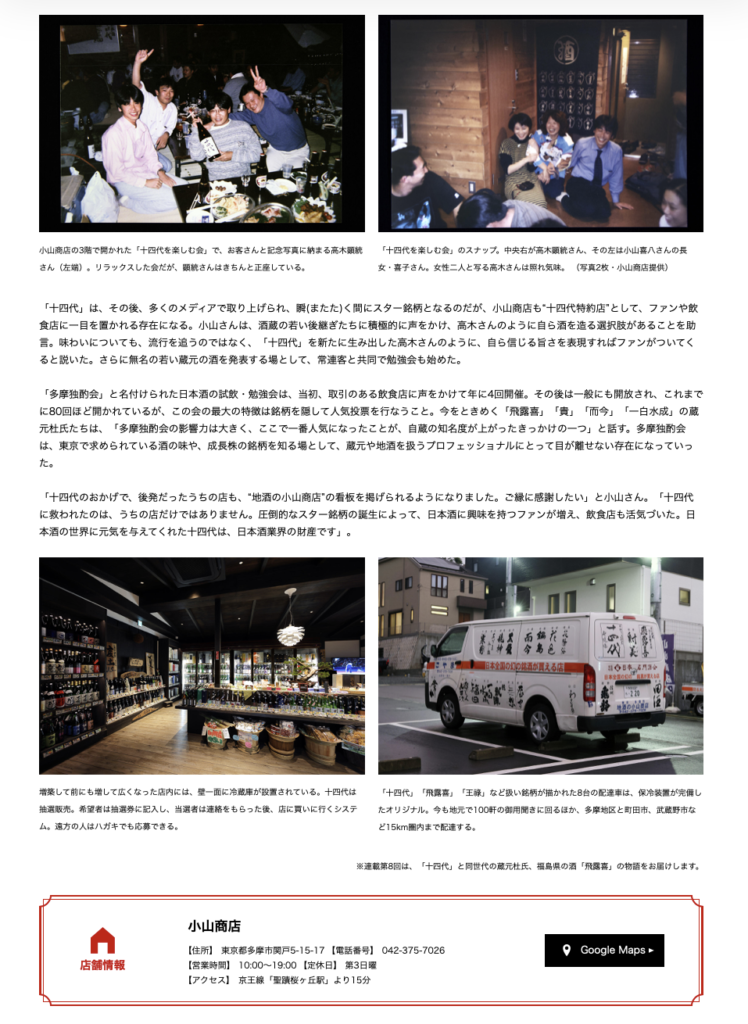
He also invited shoppers to “Enjoy Juyondai” parties on the shop’s third floor. About 30 people met each time to drink with Takagi and talk while eating Akiko’s home cooking. The gatherings lasted three years from 1994. Takagi recalls, “I drank with everyone, passed out, and always woke up in the bedroom of Koyama’s sons.” The eldest son, Yoshiaki, and second son, Yoshiharu, were high-school handball players like Takagi had been, so they hit it off.
“At breakfast I’d sit with the whole Koyama family, but everyone—from Mr. Koyama to his eldest daughter Yoshiko—was athletic, so the meal portions were huge. I couldn’t finish them,” he laughs.
Juyondai soon appeared in many media outlets and became a star label. As an official Juyondai shop, Koyama Shoten also gained fame among fans and restaurants. Koyama actively encouraged young brewery heirs, telling them they could choose to brew themselves like Takagi. He advised them to express flavors they truly believed in, not simply chase trends, assuring them fans would follow. He even started study sessions with regular customers to showcase unknown young brewers’ sake.
Named the “Tama Dokushaku-kai,” the tasting and study group first invited partner restaurants to four meetings a year, later opening to the public. About 80 sessions have been held, and its key feature is blind popularity voting. Today’s famous brewers of Hiru-ki, Taka, Jikon, and Ippakusuisei say, “Winning first place at Tama Dokushaku-kai greatly boosted our name recognition.” The group became essential for brewers and sake professionals to learn what tastes Tokyo wants and which labels are rising stars.
“Thanks to Juyondai, our once-latecomer shop can now proudly call itself ‘Koyama Shoten, the local-sake store.’ I’m grateful for the connection,” says Koyama. “Our shop isn’t the only one saved by Juyondai. The birth of such an overwhelming star attracted new fans and energized restaurants. Juyondai, which breathed life into the sake world, is a treasure for the entire industry.”